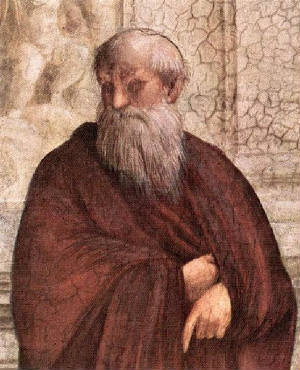
The Six Enneads
The First Ennead
First
Tractate THE ANIMATE AND THE MAN.
Pleasure
and distress, fear and courage, desire and aversion, where have these affections and experiences their seat? Clearly,
either in the Soul alone, or in the Soul as employing the body, or in some third entity deriving from both. And for this third
entity, again, there are two possible modes: it might be either a blend or a distinct form due to the blending. And
what applies to the affections applies also to whatsoever acts, physical or mental, spring from them. We have,
therefore, to examine discursive-reason and the ordinary mental action upon objects of sense, and enquire whether these have
the one seat with the affections and experiences, or perhaps sometimes the one seat, sometimes another. And we
must consider also our acts of Intellection, their mode and their seat. And this very examining principle, which
investigates and decides in these matters, must be brought to light. Firstly, what is the seat of Sense-Perception?
This is the obvious beginning since the affections and experiences either are sensations of some kind or at least never occur
apart from sensation.
This first enquiry obliges us to consider at the outset the nature of the Soul - that
is whether a distinction is to be made between Soul and Essential Soul [between an individual Soul and the Soul-Kind in itself]. If
such a distinction holds, then the Soul [in man] is some sort of a composite and at once we may agree that it is a recipient
and- if only reason allows- that all the affections and experiences really have their seat in the Soul, and with the affections
every state and mood, good and bad alike. But if Soul [in man] and Essential Soul are one and the same, then
the Soul will be an Ideal-Form unreceptive of all those activities which it imparts to another Kind but possessing within
itself that native Act of its own which Reason manifests. If this be so, then, indeed, we may think of the Soul
as an immortal- if the immortal, the imperishable, must be impassive, giving out something of itself but itself taking nothing
from without except for what it receives from the Existents prior to itself from which Existents, in that they are the nobler,
it cannot be sundered.
Now what could bring
fear to a nature thus unreceptive of all the outer? Fear demands feeling. Nor is there place for courage: courage implies
the presence of danger. And such desires as are satisfied by the filling or voiding of the body, must be proper to something
very different from the Soul, to that only which admits of replenishment and voidance. And
how could the Soul lend itself to any admixture? An essential is not mixed. Or of the intrusion of anything alien? If it did,
it would be seeking the destruction of its own nature. Pain must be equally far from it. And Grief- how or for what could
it grieve? Whatever possesses Existence is supremely free, dwelling, unchangeable, within its own peculiar nature. And can
any increase bring joy, where nothing, not even anything good, can accrue? What such an Existent is, it is unchangeably.
Thus assuredly Sense-Perception, Discursive-Reasoning; and all our ordinary
mentation are foreign to the Soul: for sensation is a receiving- whether of an Ideal-Form or of an impassive body- and reasoning
and all ordinary mental action deal with sensation. The question still remains to be examined in the matter of
the intellections- whether these are to be assigned to the Soul- and as to Pure-Pleasure, whether this belongs to the Soul
in its solitary state.
We may treat of the
Soul as in the body - whether it be set above it or actually within it - since the association of the two constitutes the
one thing called the living organism, the Animate. Now from this relation, from the
Soul using the body as an instrument, it does not follow that the Soul must share the body's experiences: a man does not himself
feel all the experiences of the tools with which he is working. It may be objected
that the Soul must however, have Sense-Perception since its use of its instrument must acquaint it with the external conditions,
and such knowledge comes by way of sense.
Thus,
it will be argued, the eyes are the instrument of seeing, and seeing may bring distress to the soul: hence the Soul may feel
sorrow and pain and every other affection that belongs to the body; and from this again will spring desire, the Soul seeking
the mending of its instrument. But, we ask, how, possibly, can these affections pass from body to Soul? Body
may communicate qualities or conditions to another body: but- body to Soul? Something happens to A; does that make it happen
to B? As long as we have agent and instrument, there are two distinct entities; if the Soul uses the body it is separate from
it. But apart from the philosophical separation how does Soul stand to body?
Clearly there is a combination. And for this several modes are possible.
There might be a complete coalescence: Soul might be interwoven through the body: or it might be an Ideal-Form detached or
an Ideal-Form in governing contact like a pilot: or there might be part of the Soul detached and another part in contact,
the disjoined part being the agent or user, the conjoined part ranking with the instrument or thing used. In this last case
it will be the double task of philosophy to direct this lower Soul towards the higher, the agent, and except in so far as
the conjunction is absolutely necessary, to sever the agent from the instrument, the body, so that it need not forever have
its Act upon or through this inferior. Let us consider, then, the hypothesis
of a coalescence.
Now if there is a coalescence, the lower is ennobled, the nobler degraded; the body is
raised in the scale of being as made participant in life; the Soul, as associated with death and unreason, is brought lower.
How can a lessening of the life-quality produce an increase such as Sense-Perception? No: the body has acquired life, it is
the body that will acquire, with life, sensation and the affections coming by sensation. Desire, then, will belong to the
body, as the objects of desire are to be enjoyed by the body. And fear, too, will belong to the body alone; for it is the
body's doom to fail of its joys and to perish. Then again we should have to examine how such a coalescence could
be conceived: we might find it impossible: perhaps all this is like announcing the coalescence of things utterly incongruous
in kind, let us say of a line and whiteness.
Next
for the suggestion that the Soul is interwoven through the body: such a relation would not give woof and warp community of
sensation: the interwoven element might very well suffer no change: the permeating soul might remain entirely untouched by
what affects the body- as light goes always free of all it floods- and all the more so, since, precisely, we are asked to
consider it as diffused throughout the entire frame. Under such an interweaving, then,
the Soul would not be subjected to the body's affections and experiences: it would be present rather as Ideal-Form in Matter.
Let us then suppose Soul to be in body as Ideal-Form in Matter.
Now if - the first possibility - the Soul is an essence, a self-existent, it can be present only
as separable form and will therefore all the more decidedly be the Using-Principle [and therefore unaffected]. Suppose, next, the Soul to be present like axe-form on iron: here, no doubt, the form is all important
but it is still the axe, the complement of iron and form, that effects whatever is effected by the iron thus modified: on
this analogy, therefore, we are even more strictly compelled to assign all the experiences of the combination to the body:
their natural seat is the material member, the instrument, the potential recipient of life. Compare the passage where we read* that "it is absurd to suppose that the Soul weaves"; equally absurd to
think of it as desiring, grieving. All this is rather in the province of something which we may call the Animate.
Now this Animate might be merely the body as having life: it might be the
Couplement of Soul and body: it might be a third and different entity formed from both. The Soul in turn- apart
from the nature of the Animate- must be either impassive, merely causing Sense-Perception in its yoke-fellow, or sympathetic;
and, if sympathetic, it may have identical experiences with its fellow or merely correspondent experiences: desire for example
in the Animate may be something quite distinct from the accompanying movement or state in the desiring faculty. The
body, the live-body as we know it, we will consider later.
Let us take first the Couplement of body and Soul. How could suffering, for example, be seated in this Couplement?
It may be suggested that some unwelcome state of the body produces a distress which reaches to a Sensitive-Faculty which in
turn merges into Soul. But this account still leaves the origin of the sensation unexplained. Another suggestion might be that all is due to an opinion or judgement: some evil seems to have befallen the man or
his belongings and this conviction sets up a state of trouble in the body and in the entire Animate. But this account leaves
still a question as to the source and seat of the judgement: does it belong to the Soul or to the Couplement?
Besides, the judgement that evil is present does not involve the feeling of grief: the judgement
might very well arise and the grief by no means follow: one may think oneself slighted and yet not be angry; and the appetite
is not necessarily excited by the thought of a pleasure. We are, thus, no nearer than before to any warrant for assigning
these affections to the Couplement. Is it any
explanation to say that desire is vested in a Faculty-of-desire and anger in the Irascible-Faculty and, collectively, that
all tendency is seated in the Appetitive-Faculty?
Such a
statement of the facts does not help towards making the affections common to the Couplement; they might still be seated either
in the Soul alone or in the body alone. On the one hand if the appetite is to be stirred, as in the carnal passion, there
must be a heating of the blood and the bile, a well-defined state of the body; on the other hand, the impulse towards The Good cannot be a joint affection, but, like certain others too, it would belong necessarily
to the Soul alone. Reason, then, does not permit us to assign all the affections to
the Couplement. In the case of carnal desire, it will certainly be the Man that desires,
and yet, on the other hand, there must be desire in the Desiring-Faculty as well.
How can this be? Are we to suppose that, when the man originates the desire, the Desiring-Faculty
moves to the order? How could the Man have come to desire at all unless through a prior activity in the Desiring-Faculty?
Then it is the Desiring-Faculty that takes the lead? Yet how, unless the body be first in the appropriate condition?
It may
seem reasonable to lay down as a law that when any powers are contained by a recipient, every action or state expressive of
them must be the action or state of that recipient, they themselves remaining unaffected as merely furnishing efficiency.
But if this were so, then, since the Animate is the recipient of the Causing-Principle [i.e., the Soul] which
brings life to the Couplement, this Cause must itself remain unaffected, all the experiences and expressive activities of
the life being vested in the recipient, the Animate.
But this would mean that life itself belongs not to the Soul but to the Couplement; or at least the
life of the Couplement would not be the life of the Soul; Sense-Perception would belong not to the Sensitive-Faculty but to
the container of the faculty. But if sensation is a movement traversing the body and culminating in Soul, how
the soul lack sensation? The very presence of the Sensitive-Faculty must assure sensation to the Soul. Once again,
where is Sense-Perception seated?
In the Couplement.
Yet how can the Couplement have sensation independently of action in the Sensitive-Faculty, the Soul left out of count and
the Soul-Faculty? 7. The truth lies in the Consideration that the Couplement
subsists by virtue of the Soul's presence. This, however, is not to say that the Soul gives itself as it is in itself to form
either the Couplement or the body. No; from the organized body and something else, let us say a light, which
the Soul gives forth from itself, it forms a distinct Principle, the Animate; and in this Principle are vested Sense-Perception
and all the other experiences found to belong to the Animate. But the "We"? How have We Sense-Perception?
By the fact that We are not separate from the Animate so constituted, even though certainly other
and nobler elements go to make up the entire many-sided nature of Man. The faculty of perception in the Soul cannot act by
the immediate grasping of sensible objects, but only by the discerning of impressions printed upon the Animate by sensation:
these impressions are already Intelligibles while the outer sensation is a mere phantom of the other [of that in the Soul]
which is nearer to Authentic-Existence as being an impassive reading of Ideal-Forms. And
by means of these Ideal-Forms, by which the Soul wields single lordship over the Animate, we have Discursive-Reasoning, Sense-Knowledge
and Intellection. From this moment we have peculiarly the We: before this there was only the "Ours"; but at this
stage stands the WE [the authentic Human-Principle] loftily presiding over the Animate.
There is no reason why the entire compound entity should not be described
as the Animate or Living-Being mingled in a lower phase, but above that point the beginning of the veritable man, distinct
from all that is kin to the lion, all that is of the order of the multiple brute. And since The Man, so understood, is essentially
the associate of the reasoning Soul, in our reasoning it is this "We" that reasons, in that the use and act of reason
is a characteristic Act of the Soul. 8. And towards the Intellectual-Principle what is our relation? By this
I mean, not that faculty in the soul which is one of the emanations from the Intellectual-Principle, but The Intellectual-Principle
itself [Divine-Mind]. This also we possess as the summit of our being. And we have It either as common to all
or as our own immediate possession: or again we may possess It in both degrees, that is in common, since It is indivisible-
one, everywhere and always Its entire self- and severally in that each personality possesses It entire in the First-Soul [i.e.
in the Intellectual as distinguished from the lower phase of the Soul]. Hence we possess the Ideal-Forms also
after two modes: in the Soul, as it were unrolled and separate; in the Intellectual-Principle, concentrated, one. And how do we possess
the Divinity?
In that the Divinity is contained in the Intellectual-Principle and Authentic-Existence;
and We come third in order after these two, for the We is constituted by a union of the supreme, the undivided Soul - we read-
and that Soul which is divided among [living] bodies. For, note, we inevitably think of the Soul, though one undivided in
the All, as being present to bodies in division: in so far as any bodies are Animates, the Soul has given itself to each of
the separate material masses; or rather it appears to be present in the bodies by the fact that it shines into them: it makes
them living beings not by merging into body but by giving forth, without any change in itself, images or likenesses of itself
like one face caught by many mirrors. The first of these images is Sense-Perception seated in the Couplement; and from this
downwards all the successive images are to be recognized as phases of the Soul in lessening succession from one another, until
the series ends in the faculties of generation and growth and of all production of offspring- offspring efficient in its turn,
in contradistinction to the engendering Soul which [has no direct action within matter but] produces by mere inclination towards
what it fashions.
That Soul, then, in us,
will in its nature stand apart from all that can cause any of the evils which man does or suffers; for all such evil, as we
have seen, belongs only to the Animate, the Couplement. But there is a difficulty in
understanding how the Soul can go guiltless if our mentation and reasoning are vested in it: for all this lower kind of knowledge
is delusion and is the cause of much of what is evil. When we have done evil it is
because we have been worsted by our baser side- for a man is many- by desire or rage or some evil image: the misnamed reasoning
that takes up with the false, in reality fancy, has not stayed for the judgement of the Reasoning-Principle: we have acted
at the call of the less worthy, just as in matters of the sense-sphere we sometimes see falsely because we credit only the
lower perception, that of the Couplement, without applying the tests of the Reasoning-Faculty.
The
Intellectual-Principle has held aloof from the act and so is guiltless; or, as we may state it, all depends on whether we
ourselves have or have not put ourselves in touch with the Intellectual-Realm either in the Intellectual-Principle or within
ourselves; for it is possible at once to possess and not to use. Thus we have marked off what belongs to the
Couplement from what stands by itself: the one group has the character of body and never exists apart from body, while all
that has no need of body for its manifestation belongs peculiarly to Soul: and the Understanding, as passing judgement upon
Sense-Impressions, is at the point of the vision of Ideal-Forms, seeing them as it were with an answering sensation (i.e,
with consciousness) this last is at any rate true of the Understanding in the Veritable Soul. For Understanding, the true,
is the Act of the Intellections: in many of its manifestations it is the assimilation and reconciliation of the outer to the
inner. Thus in spite of all, the Soul is at peace as to itself and within itself: all the changes and all the
turmoil we experience are the issue of what is subjoined to the Soul, and are, as have said, the states and experiences of this elusive "Couplement."
It will be objected, that if the Soul constitutes the We [the personality]
and We are subject to these states then the Soul must be subject to them, and similarly that what We do must be done by the
Soul. But it has been observed that the Couplement, too- especially before our emancipation- is a member of this
total We, and in fact what the body experiences we say We experience. This then covers two distinct notions; sometimes it
includes the brute-part, sometimes it transcends the brute. The body is brute touched to life; the true man is the other,
going pure of the body, natively endowed with the virtues which belong to the Intellectual-Activity, virtues whose seat is
the Separate Soul, the Soul which even in its dwelling here may be kept apart. [This Soul constitutes the human being] for
when it has wholly withdrawn, that other Soul which is a radiation [or emanation] from it withdraws also, drawn after it.
Those virtues, on the other hand, which spring not from contemplative wisdom but from custom or practical discipline
belong to the Couplement: to the Couplement, too, belong the vices; they are its repugnances, desires, sympathies. And
Friendship? This emotion belongs sometimes to the lower part, sometimes
to the interior man.
In childhood the main activity is in the Couplement and there is but little irradiation from the higher
principles of our being: but when these higher principles act but feebly or rarely upon us their action is directed towards
the Supreme; they work upon us only when they stand at the mid-point. But does not the include that phase of our being which
stands above the mid-point? It does, but on condition that we lay hold of it: our entire nature is not ours at
all times but only as we direct the mid-point upwards or downwards, or lead some particular phase of our nature from potentiality
or native character into act. And the animals, in what way or degree do they possess the Animate? If
there be in them, as the opinion goes, human Souls that have sinned, then the Animating-Principle in its separable phase does
not enter directly into the brute; it is there but not there to them; they are aware only of the image of the Soul [only of
the lower Soul] and of that only by being aware of the body organised and determined by that image. If there
be no human Soul in them, the Animate is constituted for them by a radiation from the All-Soul. 12. But if Soul
is sinless, how come the expiations? Here surely is a contradiction; on the one side the Soul is above all guilt; on the other,
we hear of its sin, its purification, its expiation; it is doomed to the lower world, it passes from body to body. We
may take either view at will: they are easily reconciled.
When we tell of the sinless Soul, we make Soul and Essential-Soul one and the same: it is the simple
unbroken Unity. By the Soul subject to sin we indicate a groupment, we include
that other, that phase of the Soul which knows all the states and passions: the Soul in this sense is compound, all-inclusive:
it falls under the conditions of the entire living experience: this compound it is that sins; it is this, and not the other,
that pays penalty. It is in this sense that we read of the Soul: "We saw it as those others saw the sea-god Glaukos."
"And," reading on, "if we mean to discern the nature of the Soul we must strip it free of all that has gathered
about it, must see into the philosophy of it, examine with what Existences it has touch and by kinship to what Existences
it is what it is." Thus the Life is one thing, the Act is another and the Expiator yet another. The retreat
and sundering, then, must be not from this body only, but from every alien accruement. Such accruement takes place at birth;
or rather birth is the coming-into-being of that other [lower] phase of the Soul. For the meaning of birth has been indicated
elsewhere; it is brought about by a descent of the Soul, something being given off by the Soul other than that actually coming
down in the declension.
Then
the Soul has let this image fall? And this declension is it not certainly sin? If the declension is no more than
the illuminating of an object beneath, it constitutes no sin: the shadow is to be attributed not to the luminary but to the
object illuminated; if the object were not there, the light could cause no shadow. And the Soul is said to go
down, to decline, only in that the object it illuminates lives by its life. And it lets the image fall only if there be nothing
near to take it up; and it lets it fall, not as a thing cut off, but as a thing that ceases to be: the image has no further
being when the whole Soul is looking toward the Supreme. The poet, too, in the story of Hercules, seems to give
this image separate existence; he puts the shade of Hercules in the lower world and Hercules himself among the gods: treating
the hero as existing in the two realms at once, he gives us a twofold Hercules. It is not difficult to explain
this distinction. Hercules was a hero of practical virtue. By his noble serviceableness he was worthy to be a God. On the
other hand, his merit was action and not the Contemplation which would place him unreservedly in the higher realm. Therefore
while he has place above, something of him remains below. And the principle that reasons out these matters? Is
it We or the Soul? We, but by the Soul.
But how "by the Soul"? Does this mean that the Soul reasons by possession [by contact with
the matters of enquiry]? No; by the fact of being Soul. Its Act subsists without
movement; or any movement that can be ascribed to it must be utterly distinct from all corporal movement and be simply the
Soul's own life. And Intellection in us is twofold: since the Soul is intellective, and Intellection is the highest phase
of life, we have Intellection both by the characteristic Act of our Soul and by the Act of the Intellectual-Principle upon
us- for this Intellectual-Principle is part of us no less than the Soul, and towards it we are ever rising.
Second Tractate
ON VIRTUE. Since Evil is here, "haunting this world by necessary law," and
it is the Soul's design to escape from Evil, we must escape hence. But what is this escape?
"In attaining Likeness to God," we read. And this is explained as "becoming
just and holy, living by wisdom," the entire nature grounded in Virtue. But
does not Likeness by way of Virtue imply Likeness to some being that has Virtue? To what Divine Being, then, would our Likeness
be? To the Being - must we not think?- in Which, above all, such excellence seems to inhere, that is to the Soul of the Kosmos
and to the Principle ruling within it, the Principle endowed with a wisdom most wonderful. What could be more fitting than
that we, living in this world, should become Like to its ruler?
But, at the beginning, we are met by the doubt whether even in this Divine-Being all the virtues find
place- Moral-Balance [Sophrosyne], for example; or Fortitude where there can be no danger since nothing is alien; where there
can be nothing alluring whose lack could induce the desire of possession. If, indeed, that aspiration towards
the Intelligible which is in our nature exists also in this Ruling-Power, then need not look elsewhere for the source of order
and of the virtues in ourselves. But does this Power possess the Virtues?
We cannot expect to find There what are called the Civic Virtues, the Prudence which belongs to the reasoning faculty; the
Fortitude which conducts the emotional and passionate nature; the Sophrosyne which consists in a certain pact, in a concord
between the passionate faculty and the reason; or Rectitude which is the due application of all the other virtues as each
in turn should command or obey. Is Likeness, then, attained, perhaps, not by these virtues of the social order but by those
greater qualities known by the same general name? And if so do the Civic Virtues give us no help at all? It is against
reason, utterly to deny Likeness by these while admitting it by the greater: tradition at least recognizes certain men of
the civic excellence as divine, and we must believe that these too had in some sort attained Likeness: on both levels there
is virtue for us, though not the same virtue. Now, if it be admitted that Likeness is possible, though by a varying
use of different virtues and though the civic virtues do not suffice, there is no reason why we should not, by virtues peculiar
to our state, attain Likeness to a model in which virtue has no place. But is that conceivable?
When warmth comes in to make anything warm, must there needs be something to warm the
source of the warmth? If a fire is to warm something else, must there be a fire to warm that fire? Against the
first illustration it may be retorted that the source of the warmth does already contain warmth, not by an infusion but as
an essential phase of its nature, so that, if the analogy is to hold, the argument would make Virtue something communicated
to the Soul but an essential constituent of the Principle from which the Soul attaining Likeness absorbs it. Against
the illustration drawn from the fire, it may be urged that the analogy would make that Principle identical with virtue, whereas
we hold it to be something higher. The objection would be valid if what the soul takes in were one and the same
with the source, but in fact virtue is one thing, the source of virtue quite another. The material house is not identical
with the house conceived in the intellect, and yet stands in its likeness: the material house has distribution and order while
the pure idea is not constituted by any such elements; distribution, order, symmetry are not parts of an idea.
So with us: it is from the Supreme that we derive order and distribution
and harmony, which are virtues in this sphere: the Existences There, having no need of harmony, order or distribution, have
nothing to do with virtue; and, none the less, it is by our possession of virtue that we become like to Them. Thus
much to show that the principle that we attain Likeness by virtue in no way involves the existence of virtue in the Supreme.
But we have not merely to make a formal demonstration: we must persuade as well as demonstrate.
First,
then, let us examine those good qualities by which we hold Likeness comes, and seek to establish what is this thing which,
as we possess it, in transcription, is virtue but as the Supreme possesses it, is in the nature of an exemplar or archetype
and is not virtue. We must first distinguish two modes of Likeness. There is the likeness demanding an identical nature in the objects which, further, must draw their likeness
from a common principle: and there is the case in which B resembles A, but A is a Primal, not concerned about B and not said
to resemble B. In this second case, likeness is understood in a distinct sense: we no longer look for identity of nature,
but, on the contrary, for divergence since the likeness has come about by the mode of difference.
What, then, precisely is Virtue, collectively and in
the particular? The clearer method will be to begin with the particular, for so the common element by which all the forms
hold the general name will readily appear. The Civic Virtues, on which we have touched above, are a principle or order and
beauty in us as long as we remain passing our life here: they ennoble us by setting bound and measure to our desires and to
our entire sensibility, and dispelling false judgement- and this by sheer efficacy of the better, by the very setting of the
bounds, by the fact that the measured is lifted outside of the sphere of the unmeasured and lawless.
And, further, these Civic Virtues- measured and ordered themselves and acting
as a principle of measure to the Soul which is as Matter to their forming- are like to the measure reigning in the over-world,
and they carry a trace of that Highest Good in the Supreme; for, while utter measurelessness is brute Matter and wholly outside
of Likeness, any participation in Ideal-Form produces some corresponding degree of Likeness to the formless Being There. And
participation goes by nearness: the Soul nearer than the body, therefore closer akin, participates more fully and shows a
godlike presence, almost cheating us into the delusion that in the Soul we see God entire. This is the way in
which men of the Civic Virtues attain Likeness.
We
come now to that other mode of Likeness which, we read, is the fruit of the loftier virtues: discussing this we shall penetrate
more deeply into the essence of the Civic Virtue and be able to define the nature of the higher kind whose existence we shall
establish beyond doubt. To Plato, unmistakably, there are two distinct orders
of virtue, and the civic does not suffice for Likeness: "Likeness to God," he says, "is a flight from this
world's ways and things": in dealing with the qualities of good citizenship he does not use the simple term Virtue but
adds the distinguishing word civic: and elsewhere he declares all the virtues without exception to be purifications. But in
what sense can we call the virtues purifications, and how does purification issue in Likeness?
As the Soul is evil by being interfused with the body, and by coming to
share the body's states and to think the body's thoughts, so it would be good, it would be possessed of virtue, if it threw
off the body's moods and devoted itself to its own Act- the state of Intellection and Wisdom- never allowed the passions of
the body to affect it- the virtue of Sophrosyne- knew no fear at the parting from the body- the virtue of Fortitude- and if
reason and the Intellectual-Principle ruled- in which state is Righteousness. Such a disposition in the Soul, become thus
intellective and immune to passion, it would not be wrong to call Likeness to God; for the Divine, too, is pure and the Divine-Act
is such that Likeness to it is Wisdom. But would not this make virtue a state of the Divine also?
No: the Divine has no states; the state is in the Soul. The Act of Intellection in the Soul
is not the same as in the Divine: of things in the Supreme, Soul grasps some after a mode of its own, some not at all. Then yet again, the one word Intellection covers two distinct Acts? Rather there is primal
Intellection and there is Intellection deriving from the Primal and of other scope. As speech is the echo of
the thought in the Soul, so thought in the Soul is an echo from elsewhere: that is to say, as the uttered thought is an image
of the soul-thought, so the soul-thought images a thought above itself and is the interpreter of the higher sphere. Virtue,
in the same way, is a thing of the Soul: it does not belong to the Intellectual-Principle or to the Transcendence.
We come, so, to the question whether Purification is the whole of this human
quality, virtue, or merely the forerunner upon which virtue follows? Does virtue imply the achieved state of purification
or does the mere process suffice to it, Virtue being something of less perfection than the accomplished pureness which is
almost the Term? To have been purified is to have cleansed away everything alien: but
Goodness is something more. If before the impurity entered there was Goodness, the
Goodness suffices; but even so, not the act of cleansing but the cleansed thing that emerges will be The Good. And it remains
to establish what this emergent is. It can scarcely prove to be The Good: The Absolute
Good cannot be thought to have taken up its abode with Evil. We can think of it only as something of the nature of good but
paying a double allegiance and unable to rest in the Authentic Good.
The Soul's true Good is in devotion to the Intellectual-Principle, its kin; evil to the
Soul lies in frequenting strangers. There is no other way for it than to purify itself and so enter into relation with its
own; the new phase begins by a new orientation. After the Purification, then, there is still this orientation
to be made? No: by the purification the true alignment stands accomplished. The Soul's virtue, then, is this
alignment? No: it is what the alignment brings about within. And this is...?
That it sees; that, like sight affected by the thing seen, the soul admits the
imprint, graven upon it and working within it, of the vision it has come to. But
was not the Soul possessed of all this always, or had it forgotten? What it now sees, it certainly always possessed, but as
lying away in the dark, not as acting within it: to dispel the darkness, and thus come to knowledge of its inner content,
it must thrust towards the light. Besides, it possessed not the originals but images, pictures; and these it
must bring into closer accord with the verities they represent. And, further, if the Intellectual-Principle is said to be
a possession of the Soul, this is only in the sense that It is not alien and that the link becomes very close when the Soul's
sight is turned towards It: otherwise, ever-present though It be, It remains foreign, just as our knowledge, if it does not
determine action, is dead to us.
So
we come to the scope of the purification: that understood, the nature of Likeness becomes clear. Likeness to what Principle?
Identity with what God? The question is substantially this: how far does purification dispel the two orders of
passion- anger, desire and the like, with grief and its kin- and in what degree the disengagement from the body is possible.
Disengagement means simply that the soul withdraws to its own place. It will hold itself above all
passions and affections. Necessary pleasures and all the activity of the senses it will employ only for medicament and assuagement
lest its work be impeded. Pain it may combat, but, failing the cure, it will bear meekly and ease it by refusing assent to
it.
All passionate action it will
check: the suppression will be complete if that be possible, but at worst the Soul will never itself take fire but will keep
the involuntary and uncontrolled outside its precincts and rare and weak at that. The Soul has nothing to dread, though no
doubt the involuntary has some power here too: fear therefore must cease, except so far as it is purely monitory. What desire
there may be can never be for the vile; even the food and drink necessary for restoration will lie outside of the Soul's attention,
and not less the sexual appetite: or if such desire there must be, it will turn upon the actual needs of the nature and be
entirely under control; or if any uncontrolled motion takes place, it will reach no further than the imagination, be no more
than a fleeting fancy.
The
Soul itself will be inviolately free and will be working to set the irrational part of the nature above all attack, or if
that may not be, then at least to preserve it from violent assault, so that any wound it takes may be slight and be healed
at once by virtue of the Soul's presence, just as a man living next door to a Sage would profit by the neighbourhood, either
in becoming wise and good himself or, for sheer shame, never venturing any act which the nobler mind would disapprove. There
will be no battling in the Soul: the mere intervention of Reason is enough: the lower nature will stand in such awe of Reason
that for any slightest movement it has made it will grieve, and censure its own weakness, in not having kept low and still
in the presence of its lord.
In
all this there is no sin- there is only matter of discipline- but our concern is not merely to be sinless but to be God. As
long as there is any such involuntary action, the nature is twofold, God and Demi-God, or rather God in association with a
nature of a lower power: when all the involuntary is suppressed, there is God unmingled, a Divine Being of those that follow
upon The First. For, at this height, the man is the very being that came from the Supreme. The primal excellence
restored, the essential man is There: entering this sphere, he has associated himself with the reasoning phase of his nature
and this he will lead up into likeness with his highest self, as far as earthly mind is capable, so that if possible it shall
never be inclined to, and at the least never adopt, any course displeasing to its overlord. What form, then,
does virtue take in one so lofty?
It appears
as Wisdom, which consists in the contemplation of all that exists in the Intellectual-Principle, and as the immediate presence
of the Intellectual-Principle itself. And each of these has two modes or aspects:
there is Wisdom as it is in the Intellectual-Principle and as in the Soul; and there is the Intellectual-Principle as it is
present to itself and as it is present to the Soul: this gives what in the Soul is Virtue, in the Supreme not Virtue. In the
Supreme, then, what is it?
Its proper
Act and Its Essence. That Act and Essence of the Supreme, manifested in a new form, constitute the virtue of this sphere.
For the Supreme is not self-existent justice, or the Absolute of any defined virtue: it is, so to speak, an exemplar, the
source of what in the soul becomes virtue: for virtue is dependent, seated in something not itself; the Supreme is self-standing,
independent. But taking Rectitude to be the due ordering of faculty, does it not
always imply the existence of diverse parts? No: There is a Rectitude of Diversity appropriate to what has parts, but there
is another, not less Rectitude than the former though it resides in a Unity. And the authentic Absolute-Rectitude is the Act
of a Unity upon itself, of a Unity in which there is no this and that and the other.
On this principle, the supreme Rectitude of the Soul is that it direct its
Act towards the Intellectual-Principle: its Restraint (Sophrosyne) is its inward bending towards the Intellectual-Principle;
its Fortitude is its being impassive in the likeness of That towards which its gaze is set, Whose nature comports an impassivity
which the Soul acquires by virtue and must acquire if it is not to be at the mercy of every state arising in its less noble
companion.
The virtues in the Soul
run in a sequence correspondent to that existing in the over-world, that is among their exemplars in the Intellectual-Principle.
In the Supreme, Intellection constitutes Knowledge and Wisdom; self-concentration is Sophrosyne; Its proper Act
is Its Dutifulness; Its Immateriality, by which It remains inviolate within Itself is the equivalent of Fortitude.
In the Soul, the direction of vision towards the Intellectual-Principle is Wisdom and Prudence,
soul-virtues not appropriate to the Supreme where Thinker and Thought are identical. All the other virtues have similar correspondences.
And if the term of purification is the production of a pure being, then the purification
of the Soul must produce all the virtues; if any are lacking, then not one of them is perfect. And to possess the greater is potentially to possess the minor, though the minor need not carry the greater with them.
Thus we have indicated the dominant note in the life of the Sage; but whether his possession
of the minor virtues be actual as well as potential, whether even the greater are in Act in him or yield to qualities higher
still, must be decided afresh in each several case.
Take, for example, Contemplative-Wisdom. If other guides of conduct must be called in to meet a
given need, can this virtue hold its ground even in mere potentiality? And what happens
when the virtues in their very nature differ in scope and province? Where, for example, Sophrosyne would allow certain acts
or emotions under due restraint and another virtue would cut them off altogether? And is it not clear that all may have to
yield, once Contemplative-Wisdom comes into action?
The
solution is in understanding the virtues and what each has to give: thus the man will learn to work with this or that as every
several need demands. And as he reaches to loftier principles and other standards these in turn will define his conduct: for
example, Restraint in its earlier form will no longer satisfy him; he will work for the final Disengagement; he will live,
no longer, the human life of the good man- such as Civic Virtue commends- but, leaving this beneath him, will take up instead
another life, that of the Gods. For it is to the Gods, not to the Good, that our Likeness must look: to model
ourselves upon good men is to produce an image of an image: we have to fix our gaze above the image and attain Likeness to
the Supreme Exemplar.